skip to main |
skip to sidebar
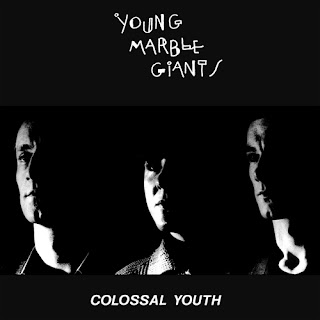 71.colossal youthyoung marble giants [rough trade, 1980]if punk was a reaction to the gaudy ostentation of popular music in the 1970s - the soppy hoariness of AM radio, the overwrought bombast of the stadium, and the coked-out decadent sheen of the discotheque - this record may be the purest example of the counter-mainstream D.I.Y. approach punk suggested. recorded cheaply, all first takes and few overdubs, and released on a then-unknown independent label, Colossal Youth opts for stark minimalism over grandiosity, reflective contemplation over brash confrontation. this is unmistakably a catchy, accessible pop record, yet its tenor is foreign, unfamiliar, and defiantly singular. whereas points of reference Suicide and Silver Apples were noisy, if not hostile, Young Marble Giants are somber, quiet, and as austere as an abandoned bunker or a desolate provincial cemetery. even within the context of an era that abounded in creativity, Colossal Youth is genuinely sui generis. the structural components are consistent throughout the record: the jaunty, punctured throb of a bass, the ghostly lub-dub of a primitive drum machine, the twang and scratch of a Rickenbacker, the carnivalesque drone of a homemade synthesizer, and the deadpan near-monotone drawl of vocalist Alison Statton. just as important are the gaps, the spaces, the reverberations; Young Marble Giants aren't hoarders of sounds and Colossal Youth is as uncluttered as an obsessive compulsive's desktop, creating a near-claustrophobic tone of immediacy. the record has many revelatory moments, from the corroding calliope swirl of "the man amplifier" and the slasher film build-up of "n.i.t.a." to the sardonic, ennui-ridden bourgeois critique of "eating noddemix" and the aching poignancy of "salad days." however, the highlight - and the most pristine distillation of the record's minimalistic aesthetic - is opener "searching for mr. right," which contains Statton's most elegiac vocal melody. though it may bear little sonic similarity to the majority of British punk, Colossal Youth is a quintessential illustration of the true mission of the movement: allowing disaffected, disillusioned youths and weirdos across the nation the opportunity to create distinctive, engaging, gorgeous music.burn out, rather than fade away moment: aside from a collection of early singles, and an EP released before their disbandment, Colossal Youth is the only Young Marble Giants record. this, of course, adds to its mystique. incidentally, it was one of Kurt Cobain's favorites and Nirvana planned to cover "credit in the straight world;" Hole ended up doing so, rather horribly, on Live Through This.
 72.in uteronirvana [dgc, 1993]this is the sound of mental collapse and caged dog desperation; after the unbridled success of Nevermind, the boomer critical establishment - and millions of adoring fans - foisted the world onto Kurt Cobain's back. he was the Savior, the Voice, the Icon, the counter Jon Bon Jovi and Nirvana was the ferociously "authenic" antidote to the bloated excesses of hair metal, obliterating crass, teased-hair insincerity with righteous punk indignation. In Utero is the intrepid response to all the unwanted adulation, noisily confrontational and as caustic as a beaker of hydrochloric acid funneled down the gullet. the Freudian fury of rumbling opener "serve the servants" scorches the earth for the bulldozing "scentless apprentice" where Cobain massacres his throat over blitzkrieg guitar and Dave Grohl's panzer drums. the "loud-soft" dynamics of "heart-shaped box" and the sly allusion to "smells like teen spirit" on "rape me" acknowledge Nirvana's past before staggering off into more ominous territory, while Cobain self-deprecatingly equates his mental state to that of a deranged film starlet on "frances farmer will have her revenge on seattle." the eye of the hurricane quiet of the precocious "dumb" and the bittersweet "pennyroyal tea" counteract the sonic assault of the ironically titled "radio friendly unit shifter" and the unapologetic squall of "tourette's." "milk it" is the record's highpoint; a maelstrom of grotesque lyrics, schizophrenic guitar, mastodon-sized drums, and a creeping sense of impending doom. in the wake of Cobain's suicide, closer "all apologies" has become an elegy, and indeed the closing lyrical round of "all in all is all we are" [perhaps appropriately misconstrued as "all alone is all we are"] achieves a wistful aura of corporeal finality. this is an idiosyncratic record, off-putting and charming, defiant and droll, and an effective demonstration of why Nirvana is such a universally beloved band, regardless of critical hyperbole and misapplication.teenage angst has paid off well, now i'm bored and old momenet: hi, yeah, i'm back. due to a computer death, multiple distractions, and my inability to complete any list-based project i start, i know it's been awhile [cue Staind song]. also, i was reluctant to write this entry. it's difficult to approach a group as "universally beloved" as Nirvana, and i didn't want to fall too much into the pitfall of focusing extensively on Cobain's death. it probably shouldn't have taken me three months to get around to it, but, oh well. i AM going to finish this project. even it takes years, damnit.
 73.the bandthe band [capitol, 1969]in apposite response to the wayward discord and unchecked chaos of the 'Nam era, maple-slurpin' Canadian Robbie Robertson and his Band of merry musicians scour America's past for inspiration, seeking the source of the turbulence; the origin of the discontent; the genesis of a musical heritage that stretches back to the mountains and the fields, parlors and playhouses; the roots. this is a Bande à part backstroking against mainstream currents, a group of self-aware hipsters shucking off flower-power head-trips for headlong excursions into the dark recesses of history; this self-titled record captures them at the pinnacle of their prowess. "across the great divide" is a woozy, boozy morning-after lover's lament fueled by Levon Helm's street-corner stomp, while Rick Danko's hell-raising fiddle on "rag mama rag" threatens to set the hay on fire during a barn dance. Garth Hudson's lantern-in-the-distance Clara Barton organ hovers over the opium-addled narrator on "when you awake," while Richard Manuel's barrelhouse piano gets kicked out of the saloon on "look out cleveland." with Manuel's distraught quiver and downcast, brokenhearted lyrics, "whispering pines" is the record's emotional zenith, branching out from the rollicking, drunken ruckus of "up on cripple creek," on which Hudson's Clavinette filters through a wah-pedal for that funky bayou croak later copped by Stevie Wonder. though the old folks' home creak of "rockin' chair" comes across as patronizing, the Band's obsession with the arcane is justified by the Dust Bowl fury of "king harvest (has surely come)" and the mournful Confederate elegy of "the night they drove old dixie down," which may be the fullest realization of their sepia-toned modus operandi. with shrugged-off, nonchalant virtuosity and expertly-forged, timeless songs that would make Stephen Foster blush, The Band excavates the ghosts of the past to critique the present, setting a precedent for the disillusioned and disaffected to, for better or worse, look backwards instead of treading forwards.you talkin' to me? moment: The Last Waltz is known as the best concert film ever for many reasons - Martin Scorsese's direction [and by extension, Thelma Schoonmaker's incomparable editing], a groggy, elusive Dylan, Neil Young with blow stuck in his nostrils - but, i was impressed by just how badass the dudes in the Band dressed and acted. they were unflappable musicians, but they knew how to rock a fedora and three-piece.
 74.you forgot it in peoplebroken social scene [arts & crafts / paper bag, 2002]stylistic synthesis and grab bag eclecticism run rampant through the bushy fields of aughties indie-rock, as does the musical entity known as the "collective," an amorphous, ever-shifting conglomerate of like-minded musicians. Broken Social Scene co-founders and permanent members Kevin Drew and Brenden Canning aren't savants or savages; they're alchemists, turning the unprocessed ore of impromptu jam sessions with whoever happens to be in the studio into glittering pop gold. You Forgot It in People zigzags like an intestinal tract; it's a prodigiously diverse record with unexpected aesthetic detours down unexplored avenues. the spasmodic, herky-jerky pyrotechnics of "almost crimes" crash into the heavy-lidded hash brownie daydream of "looks just like the sun" which melts into the sun-kissed bossa nova of "pacific theme." the album is full of dazzling flourishes - the "tighten up" handclaps on "stars and sons" or Emily Haines' unsettling, broken robot vocals on "anthems for a seventeen year-old girl" - that elevate the songs above the humdrum monotony of guitar-based indie. "cause = time" may be the record's most reductive track, but it's also the most rousing - a shout-along, anti-media, anti-clerical anthem with glass smashing agent provocateur guitar freak-outs. "lover's spit" is a grandstanding, weepy Bryan Adams ballad filtered through poised detachment and winking irony, while the drum brushes and fragile guitar picking on "i'm still your fag" and the aching strings on ambient closer "pitter patter goes my heart" conclude the jamboree on a somber, quiet tone. by allowing contributions from a wide variety of individuals, You Forgot It in People achieves a sort of scattershot, paradoxical transcendence; it's sweepingly grandiose yet serenely tranquil, messily chaotic yet surprisingly cohesive, a celebration of the power of camaraderie and collaboration.stephen dreams of pavement (another day) moment: Broken Social Scene's set at Lollapalooza in 2006 may just be the best concert i've ever witnessed. the crowd was relatively small, but completely engrossed. the band, then around ten members, was energetic and fun. and, because many of the other bands in the BSS periphery were also playing the festival, most of the guest vocalists - Feist, Emily Haines, etc. - appeared on stage. they played again in 2008, but it just wasn't the same.
 75.fun housethe stooges [elektra, 1970]lock up your daughters, stash away the drugs, and pour out the booze, Iggy Pop né Stooge né James Osterberg is out of his mind on a Saturday night. he's the unhinged, wild id; a spewing, blood-spurting hot mess; the puck-like prophet of punk; an unruly lunatic throwing punches and pissing his pants in the backseat of a cop car. the Stooges outstripped, outshone, and upstaged every ragged group of no-gooders and long-hairs bangin' on three chords in garages and dimly lit bars across the country; Fun House is evidence of their dominance, a whirling dust devil of sound and fury. the blazing heat from Ron Asheton's ferocious electric storm guitar could melt glaciers, while Dave Alexander and Scott Asheton pulverize the rhythm into a bloody pulp. then, of course, there's Iggy, the preacher from Hell espousing the sins of flesh, wailing above the clangor, fighting to be heard. the clanging stomp of "down in the street" scrounges the gutter for dropped change and revels in the depravity of the puke-stained pavement, while Iggy growls and Ron's guitar howls on the gigolo blues meltdown of "loose." "tv eye" is stalker-dodging, alley-hopping amphetamine paranoia, while the "troglodyte groove" of slow-burning monster "dirt" hypnotizes its prey before pouncing at the jugular. Steve Mackay's bleating, lecherous saxophone bulldozes into the mix during the eviscerating finale of "1970" and refuses to leave the party during the shit-faced stomp of the title track. the revelry concludes with "l.a. blues," a formless cacophony of noise and indignation. primal, urgent, and savage, Fun House eschews the fat, the padding, and the bullshit, targets the viscera and exposes the bleeding, palpitating core of what made rock n' roll so fucking subversive in the first place - threatening, sexual raw power.street walkin' cheetah with a heart full of napalm moment: not to detract from its glory, but fun house is really the best Stooges record by default. their self-titled debut has a few incendiary tracks, but is littered with throwaways and the plodding dirge of "we will fall." the otherwise incredible raw power is plagued by production quality issues: the original Bowie mix is muddy and dull and Pop own 1997 remaster is just too fucking loud and clipped. if a decent-sounding mix was ever released, it would fight with fun house for the prime spot.


